 fr
 es
 en
Étang de Salses-Leucate
Estany de Salses
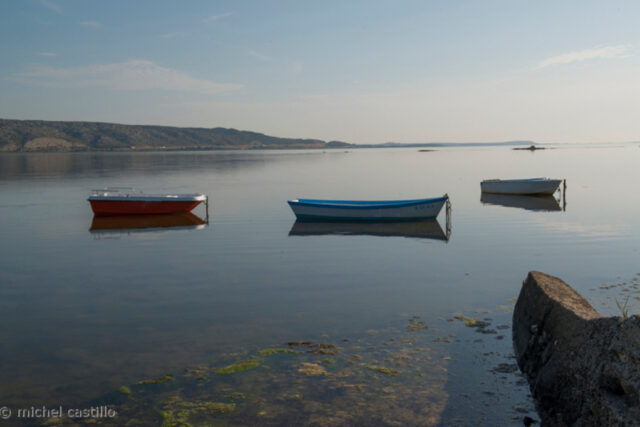
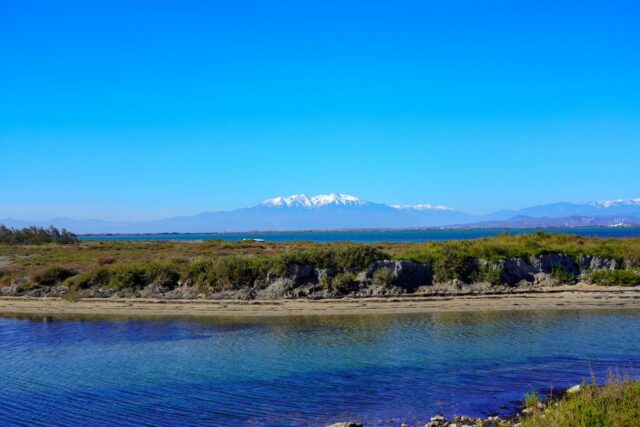
Natura 2000 · Ramsar site (2017)The second-largest lagoon in Occitanie, the étang de Salses-Leucate stretches for 14 kilometres between Roussillon and the Corbières: seagrass meadows, migratory birds, Leucate oysters, karst springs and the tramontane wind, with the Canigó on the horizon.
Visit Opening hours, prices, access and events on site ↓Overview
Straddling the Pyrénées-Orientales and the Aude, the étang de Salses-Leucate covers about 5,400 hectares, making it the second-largest lagoon in Occitanie after the Étang de Thau. It is 14 kilometres long and 6.5 kilometres across at its widest, and is separated from the sea by a sandy barrier beach, with which it communicates through three graus, created in the 20th century. Shallow, it barely exceeds two metres in depth in its northern basin.
Its distinctive feature is its fresh water, which does not come from a river: it wells up from karst springs at the foot of the Corbières, such as Font-Estramar, at Salses, and Font-Dame. Font-Estramar is one of the deepest springs in the world to have been explored by diving: divers descended below 300 metres there in 2023 and 2024.
The lagoon bed is covered with vast seagrass meadows of eelgrass, nurseries for fish. The étang lies on a major migration route: 280 species of birds have been recorded there. This natural heritage has earned it protection under Natura 2000 and, since 2017, listing as a wetland of international importance under the Ramsar Convention.
The étang is also a place for living and leisure: oysters and mussels have been farmed there since 1963, on the Leucate side, and the tramontane has made it a leading spot for windsurfing and kitesurfing. Beneath the waters of the Corrège even lies a Neolithic village, discovered during dredging in 1972.
Key figures
- Area
- about 5,400 ha
- Length
- 14 km
- Maximum width
- 6.5 km
- Graus to the sea
- 3
- Birds recorded
- 280 species
- Ramsar site
- since 2017
Wildlife, plants and landscapes
Fresh water from the Corbières
The karst springs of Font-Estramar and Font-Dame, fed in part by the Agly and the Verdouble, provide most of the étang's fresh water.
A record-breaking spring
At Font-Estramar, divers went below 300 metres in depth in 2023 and 2024, among the deepest underwater explorations in the world.
Underwater meadows
Eelgrass and widgeongrass form seagrass beds that shelter and feed fish and invertebrates.
A stopover for migrants
280 species of birds have been observed on the étang and its shores, 89 of which are protected.
Leucate oysters
Since 1963, oysters and mussels have been farmed in suspension beneath tables, in the Aude part of the étang.
A sunken village
A village from the Early Neolithic, now underwater, was discovered in 1972 at the Corrège.
When to go
The étang can be enjoyed all year round. Spring and autumn, the migration seasons, are the best times for birdwatching. The tramontane, frequent and sometimes violent, delights experienced windsurfers and kitesurfers; in summer, a gentler sea breeze often sets in during the afternoon.
Getting there
On the Pyrénées-Orientales side, the Dosses peninsula, in Le Barcarès, offers a free interpretive trail of about 2 km (45 minutes). The fishermen's huts of the Coudalère, in Le Barcarès, are also good for birdwatching. A kitesurfing spot can be found near Saint-Laurent-de-la-Salanque. On the Aude side, the Maison de l'étang, in Leucate, introduces the lagoon.
Not to be missed
- The interpretive trail of the Dosses peninsula
- The fishermen's huts of the Coudalère
- A windsurfing or kitesurfing session in the tramontane
- A tasting of Leucate oysters
- The Canigó seen from the shores of the étang
Plan your visit
Sources
- Syndicat RIVAGE Salses-Leucate : contrat d’étang n° 3
- Pôle-relais lagunes : les herbiers de l’étang de Salses-Leucate
- Pôle-relais lagunes : sentier d’interprétation des Dosses
- MedWet : site Ramsar de Salses-Leucate
- DIRM Méditerranée : bilan de la conchyliculture
- INPN : site Natura 2000 FR9101463 « Complexe lagunaire de Salses »
- Wikidata Q2038362
Text written by Éden Catalán from these sources. Spotted a mistake? Write to us.