 fr
 es
 en
Lac de la Raho
Estany de Vilanova de Raò
Ecological reserve (birds)A few kilometres from Perpignan, the lac de Villeneuve-de-la-Raho is a water reservoir that has become a place for walking and swimming, with a small bird reserve and the Canigó as a backdrop.
Visit Opening hours, prices, access and events on site ↓Overview
To the south of Perpignan, in the communes of Villeneuve-de-la-Raho, Montescot, Bages and Pollestres, the lac de la Raho fills a vast basin hollowed out by the wind over geological time. A natural lake once existed here: deemed useless, it was drained in 1854 so that the land could be cultivated.
At the end of the 1970s, the Département des Pyrénées-Orientales recreated a reservoir by damming the basin and feeding it with a diversion from the canal de Perpignan, which draws its water from the Têt. The lake, covering some 150 to 200 hectares depending on the water level, serves first and foremost as a reserve for irrigation and firefighting: in summer, it is not unusual to see the Canadair water bombers scooping up water.
The site is divided into three stretches of water: the large lake, a reservoir set aside for swimming and leisure, and a small ecological reserve to the south-west, closed to fishing and other activities, where migrating birds stop. Over the seasons, you can see pochards, egrets, great crested grebes, grey herons and kingfishers.
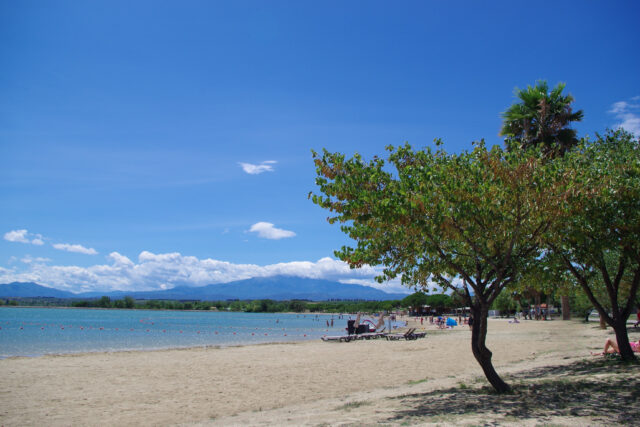
Edged by a pine wood, the lake has become the great natural space of the Perpignan conurbation: you can walk, run or cycle around it, facing the Canigó massif, and swim in it in summer in the supervised area.
Key figures
- Area
- around 150 to 200 ha depending on the water level
- Volume
- around 17 million m³
- Water supply
- canal de Perpignan (water from the Têt)
- Reservoir recreated
- late 1970s
- Ecological reserve
- around 14 ha
- Circuit of the lake
- around 7 km
Wildlife, plants and landscapes
A lake brought back to life
Drained in 1854 for agriculture, the lake was refilled by the Département in the late 1970s.
A basin hollowed out by the wind
The lake lies in a depression formed by wind erosion of ancient sediments, the largest of its kind in the plain.
A water reserve above all
The reservoir serves first for irrigation and fire protection; leisure comes second.
Canadair in action
During the fire season, water-bombing aircraft come here to fill their tanks.
A refuge for birds
The small south-west reserve, closed to fishing, welcomes migratory birds in spring and autumn.
Four communes
The lake extends over Villeneuve-de-la-Raho, Montescot, Bages and Pollestres.
When to go
The site is open and free of charge all year round. Swimming is permitted only in summer, in the designated, supervised area. For birdwatching, spring, autumn and winter are preferable, when the lake is quieter. Petrol and diesel motorboats are prohibited; sailing, rowing and windsurfing are practised here.
Getting there
The lake is about 6 km south of Perpignan. Several free car parks, toilets and picnic areas are provided; a car park to the south of the lake is the closest to the bird reserve. The circuit of the lake can be done on foot or by bike, along a flat but rather unshaded path.
Not to be missed
- The circuit of the lake, on foot or by bike, facing the Canigó
- The ecological reserve and its birds, to be watched from a distance with binoculars
- The supervised beach, in summer
- The pine wood and its picnic area
- The Canadair scooping up water during the fire season
Plan your visit
Sources
- Département des Pyrénées-Orientales : charte des manifestations du site de la Raho
- Tourisme Pyrénées-Orientales : site du lac de la Raho
- Contrat de milieu : fiche de la retenue de Villeneuve-de-la-Raho
- Agence de l’eau : synthèse du plan d’eau de Villeneuve-de-la-Raho (2012)
- INPN : ZNIEFF « Plan d’eau de la Raho »
- Wikidata Q3215574
Text written by Éden Catalán from these sources. Spotted a mistake? Write to us.