 fr
 es
 en
Le Racou
El Racó
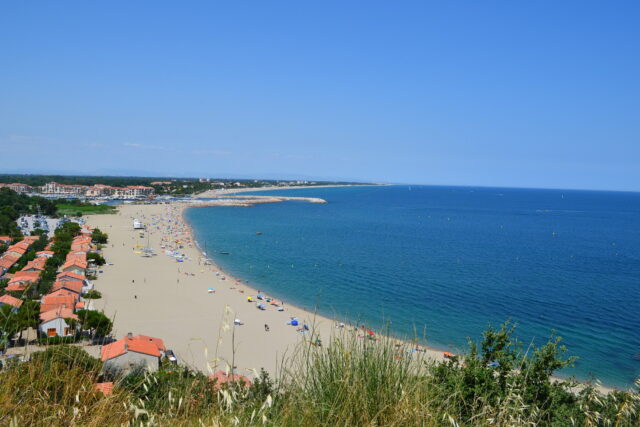
Conservatoire du littoral · Natura 2000Photo: Jean-Pierre Bazard, CC BY-SA 3.0, via Wikimedia Commons
South of Argelès-sur-Mer, the sandy beach comes to an abrupt end at the foot of the first cliffs: at Le Racou, the Pyrenees plunge into the Mediterranean and the Côte Vermeille begins, with its hamlet of cabins, its coves and its coastal path.
Visit Opening hours, prices, access and events on site ↓Overview
Le Racou, “El Racó” in Catalan, meaning the nook, marks the southern end of the great beach of Argelès-sur-Mer. After seven kilometres of sand from the Mas Larrieu, the coast changes abruptly: at the end of the beach, the first schist cliffs rise up. It is here that the Albères massif, the last foothill of the Pyrenees, plunges into the sea and that the Côte Vermeille begins, rocky and indented, all the way to the Spanish border.
Behind the beach, a small hamlet of low houses, grown out of fishermen’s cabins, stretches along sandy, flower-lined lanes. The place has inspired painters: Étienne Terrus, a friend of Matisse and Derain, painted Le Racou at the turn of the 20th century.
To preserve this landscape, the Conservatoire du littoral acquired nearly 30 hectares around the site between 1996 and 2004: the rocks of Porteils, the promontory of the En Sorra mill and the Valmarie wood. The cliffs between Le Racou and Collioure are recognised for their ecological interest and are part of the Natura 2000 network of the rocky coast of the Albères. The vegetation found here is specific to Catalonia, including the Roussillon thrift, a protected plant.
From the beach car park, the coastal path sets off, following the coves all the way to Collioure: one of the finest walks on the Catalan coast.
Key figures
- Côte sableuse d’Argelès
- 7 km, as far as Le Racou
- Côte rocheuse d’Argelès
- 2 km, from Le Racou to the Ouille
- Conservatoire du littoral
- nearly 30 ha acquired (1996-2004)
- Cliffs from Le Racou to Collioure
- ecological area of 31 ha
- Beach
- Blue Flag, supervised bathing in summer
- Path to Collioure
- about 4 km
Wildlife, plants and landscapes
From sand to rock
At the end of the beach, the sand gives way to the first schist cliffs: this is the boundary between the sandy coast of Roussillon and the Côte Vermeille.
The Pyrenees in the sea
The Albères massif, the eastern end of the Pyrenees, plunges directly into the Mediterranean here.
Catalan flora
The cliffs shelter vegetation adapted to wind and sea spray, including the Roussillon thrift, a protected species.
A small, discreet fish
The shallow sandy seabed at Le Racou is home to the amphioxus, a primitive marine animal studied by scientists.
A painter's landscape
Étienne Terrus, a painter from Elne close to the Fauves, depicted Le Racou.
A hamlet of cabins
The hamlet grew up around former fishermen's cabins, now low houses between the sand and the flowers.
When to go
The site is freely accessible all year round. The beach of Le Racou, awarded the Blue Flag, is supervised by municipal lifeguards in the summer season. For the coastal path, choose spring, autumn or the cooler hours of summer; some sections may occasionally be closed after rockfalls.
Getting there
The car park for the beach of Le Racou lies south of Port-Argelès, off the D114; it has spaces reserved for people with reduced mobility and a launching chair for entering the water. The coastal path leaves the beach towards Porteils, the cove of the Ouille and Collioure (about 4 km, allow an hour and a half to two hours).
Not to be missed
- The boundary between sand and rock, at the end of the beach
- The viewpoint indicator at the En Sorra mill and its 360° view
- The rocks and coves of Porteils
- The cove of the Ouille, on the path to Collioure
- The flower-lined lanes of the hamlet
Plan your visit
Sources
- Office de tourisme d’Argelès-sur-Mer : dossier de presse 2024
- Tourisme Pyrénées-Orientales : site naturel protégé du Racou
- Tourisme Pyrénées-Orientales : plage du Racou
- Ville d’Argelès-sur-Mer : bulletin Granotes n° 89 (2009)
- INPN : ZNIEFF 910010853 « Falaises du Racou à Collioure »
- INPN : site Natura 2000 FR9101481 « Côte rocheuse des Albères »
Text written by Éden Catalán from these sources. Spotted a mistake? Write to us.