 fr
 es
 en
Canigó Massif
Canigó
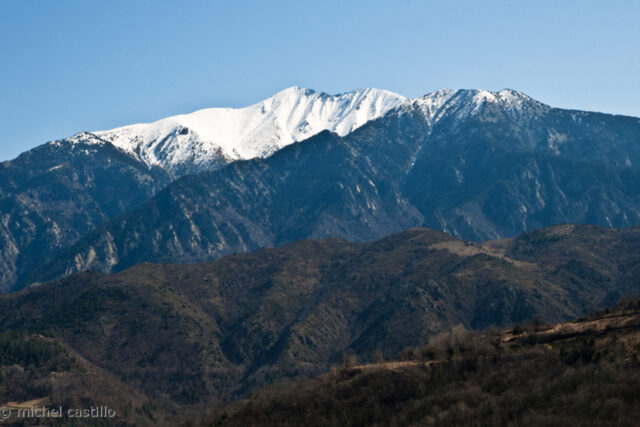
Grand Site de France · Listed siteAn emblematic mountain for the Catalans, the Canigó rises 2,784 metres above the Roussillon plain: a protected massif, awarded the Grand Site de France label, where walkers climb to the summit cross and the Saint-Jean flame.
Visit Opening hours, prices, access and events on site ↓Overview
Visible from all across the Roussillon plain and as far as the sea, the Canigó reaches 2,784 metres at its highest point. For a long time it was believed to be the highest peak in the Pyrenees; it is not, but its isolated silhouette, rising above the orchards and vineyards, makes it the landmark of the whole Catalan country.
The massif is a block of very ancient rock: granites and gneisses more than 550 million years old, together with marbles, limestones and schists. Its uplift, which accelerated around 2.5 million years ago, carved the deep gorges that surround it, such as those of the Cady and the Fou.
The Canigó is also a symbolic mountain. In 1886 the poet Jacint Verdaguer devoted his great epic poem Canigó to it. Since 1955, the “Flama del Canigó” has been rekindled here every year at Saint-Jean: the flame, kept at the Castillet of Perpignan, is carried up to the summit during the night of 22 to 23 June, then lights thousands of fires on both sides of the border.
Protected since 1951, the summit is part of a listed site that now covers more than 23,000 hectares, one of the largest in France, and of three national nature reserves (Py, Mantet and Prats-de-Mollo-la-Preste). The massif has held the Grand Site de France label since 2012, renewed in 2025 under the name “Massif et balcons du Canigó”. To preserve the mountain, motorised access has been greatly reduced: visitors climb on foot, from the “gateways” of the listed site.
Key figures
- Summit altitude
- 2,784 m
- Listed site
- more than 23,000 ha (2013)
- National nature reserves
- 3 (Py, Mantet, Prats-de-Mollo)
- Grand Site de France
- since 2012, renewed in 2025
- Municipalities of the Grand Site
- 61
- Plant species
- more than 1,700
Wildlife, plants and landscapes
Rocks 550 million years old
The heart of the massif is made of very ancient granites and gneisses; their uplift, recent on the geological scale, carved the gorges of the Cady and the Fou.
From holm oak to mountain pine
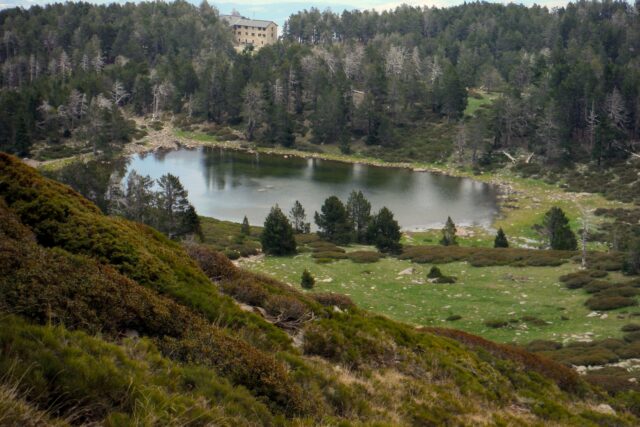
Vegetation is layered with altitude: holm oaks and cork oaks at the bottom, beeches and firs in the montane zone, then mountain pine forests between 1,700 and 2,200 m.
Rare species
Pyrenean desman and Pyrenean brook newt, bearded vulture, capercaillie: the massif shelters threatened species, and the decline of the rock ptarmigan is closely monitored there.
A record diversity
More than 1,700 plant species, more than 100 bird species and 76 ant species, more than a third of those found in France.
Visible from Marseille
In early February and late October, at sunset, the Canigó stands out against the horizon from Marseille, about 250 km away, thanks to the refraction of the air.
The Flama del Canigó
Every 22 June, the flame kept at the Castillet of Perpignan is rekindled at the summit, then lights the Saint-Jean fires in hundreds of Catalan communes.
When to go
The climb to the summit is made in summer and early autumn, free of snow and ice: on the north side, above 1,500 m, snow generally lies from December to April. The staffed mountain huts (Cortalets, Mariailles…) welcome hikers in season; the Cortalets hut will undergo renovation from July 2026, so check before setting out. In summer, start early: thunderstorms and intense heat are frequent.
Getting there
The massif is explored on foot from the "gateways" of the listed site. From Vernet-les-Bains and Casteil, the route climbs via the col de Jou and the Mariailles hut (about 1,650 m of elevation gain, often over two days). On the Prades side, the Llec track leads to the Cortalets; on the Valmanya side, the start is at Los Masos. Forest tracks are regulated to limit motor traffic: check access conditions with the Syndicat mixte Canigó Grand Site.
Not to be missed
- Sunrise at the summit, near the cross erected in 1943
- The Flama del Canigó, during the night of 22 to 23 June
- The abbeys of Saint-Martin-du-Canigou and Saint-Michel-de-Cuxa, at the foot of the massif
- The gorges of the Cady and the Fou
- The mining heritage of Batère and La Pinosa
Plan your visit
Sources
- Canigó Grand Site : histoire d’une protection
- Canigó Grand Site : géographie et biodiversité
- Canigó Grand Site : habitats naturels
- Canigó Grand Site : les refuges
- Département des Pyrénées-Orientales : renouvellement du label Grand Site de France (2025)
- Wikidata Q6650
- Viquipèdia : Flama del Canigó
Text written by Éden Catalán from these sources. Spotted a mistake? Write to us.