 fr
 es
 en
Forêt de la Massane
Bosc de la Maçana
National nature reserve (1973) · UNESCO World Heritage Site (2021)In the Albères, above Argelès, a beech forest left to evolve freely for more than a century: the Massane nature reserve, one of the best-studied forests in Europe, listed as a UNESCO World Heritage Site.
Visit Opening hours, prices, access and events on site ↓Overview
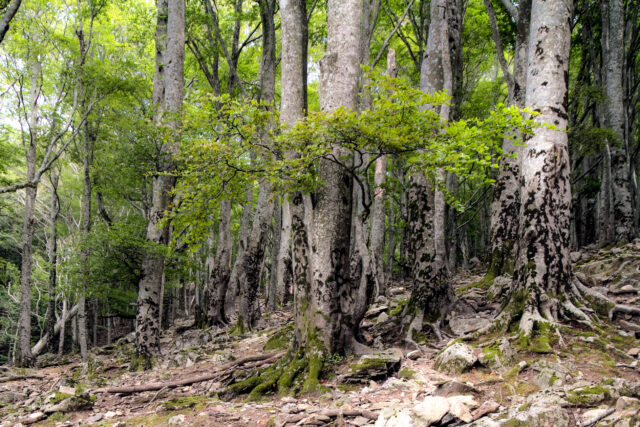
On the heights of the Albères massif, between 600 and 1,158 metres above sea level, the Massane valley shelters a forest that is rare in the Mediterranean: an old beech wood mixed with oaks, hollies, maples and yews. Its oldest beeches are up to 300 years old and reach around thirty metres in height.
This forest has not been exploited since the end of the 19th century. After centuries of felling to supply charcoal for the Catalan forges, the commune of Argelès suspended logging in the 1880s. Since then, the trees have lived, died and decomposed where they stand. The dead wood, standing or on the ground, feeds and shelters a multitude of insects, fungi, birds and small mammals.
Studied by researchers from the Arago laboratory in Banyuls since the end of the 19th century, the forest became a national nature reserve in 1973, covering 336 hectares. With some 10,000 species recorded, it presents itself as an “open-air laboratory” and one of the most thoroughly inventoried sites in the world. In 2021, it was listed as a UNESCO World Heritage Site as part of the Ancient and Primeval Beech Forests of Europe.
The reserve may be visited freely, on foot, along the waymarked paths; the GR 10 crosses it. To protect it, fires, bivouacking, picking and vehicles are prohibited, and dogs must be kept on a lead.
Key figures
- Nature reserve
- since 1973
- Area
- 336 ha
- Altitudes
- from about 600 m to 1,158 m
- Beech forest
- about 120 ha
- Species recorded
- about 10,000
- UNESCO
- listed in 2021
Wildlife, plants and landscapes
More than a century without felling
Felling stopped in the 1880s: the forest has been evolving freely for more than 130 years.
Beeches 300 years old
The oldest trees are three centuries old and around thirty metres tall.
Dead wood, a source of life
Dead trees and stumps shelter insects, fungi and lichens; they also retain moisture in the soil.
The Rosalia longicorn
This blue-grey beetle spotted with black, emblematic of old beech forests, lives on the beeches of the reserve.
An open-air laboratory
Researchers and naturalists have been inventorying the forest for more than a century; some 50,000 trees are monitored there.
A forest facing climate change
Heatwaves and droughts, such as that of 2003, weigh heavily on this beech forest at the southern limit of its range.
When to go
The reserve is open all year round and free of charge. Spring and autumn, when the beech forest changes colour, are the most beautiful times to visit. In summer, access to the Albères massifs may be restricted or prohibited when there is a fire risk: check the prefecture's daily map and the municipal orders before setting out.
Getting there
The reserve is reached on foot, most often from the hamlet of Lavall, in the commune of Sorède, via the col de l’Aranyó and the col des Trois Hêtres; the loop via the pic des Quatre Termes takes a long day. The GR 10 crosses the reserve. In summer, traffic and parking are regulated on the access roads: please use the designated car parks.
Not to be missed
- The old beech forest and its dead trees
- The pic des Quatre Termes (1,158 m) and its stone boundary marker
- The Massane river
- The Rosalia longicorn, in summer, on the beech trunks
- Nearby, the tour de la Massane and its panorama
Plan your visit
Sources
- Réserve naturelle nationale de la forêt de la Massane
- Réserve de la Massane : réglementation
- Réserve de la Massane : le projet 10 000 espèces
- Tourisme Pyrénées-Orientales : réserve de la forêt de la Massane
- DRAC Occitanie : patrimoine mondial en région
- L’info durable : la hêtraie de la Massane, une forêt inexploitée classée à l’UNESCO
- Wikidata Q3457502
Text written by Éden Catalán from these sources. Spotted a mistake? Write to us.