 fr
 es
 en
Gorges de Galamus
Gorges de Galamús
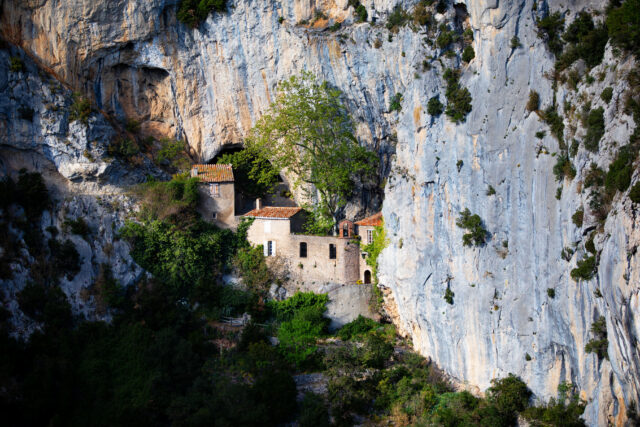
Protected site (1927)Between Fenouillèdes and Corbières, the Agly has carved a narrow passage through the limestone: a dizzying road cut in the late 19th century, pools of clear water and, clinging to the cliff, the Saint-Antoine hermitage.
Visit Opening hours, prices, access and events on site ↓Overview
North of Saint-Paul-de-Fenouillet, the Agly cuts through the mountain by a narrow defile some five kilometres long, on the border between the Pyrénées-Orientales and the Aude. The gorges are carved into limestone and dolomite folded during the formation of the Pyrenees, along the great fault that separates the range from its foothills.
Long impassable, they were opened to traffic only in the late 19th century: workmen suspended from ropes cut the road into the cliff and pierced its tunnel in 1892. Narrow, with a height restriction and nowhere to turn back, it remains one of the most impressive roads in the region, above the pools and potholes hollowed out by the river.
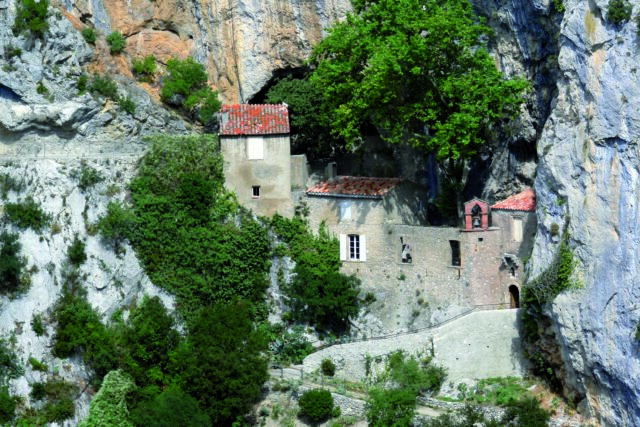
Halfway along, the Saint-Antoine de Galamus hermitage clings to the rock face, about a hundred metres above the Agly. According to tradition, hermits lived here as early as the early Middle Ages; the sanctuary is mentioned in 1474, and the chapel was built into a large natural cave in the late 18th century. Sold as national property during the Revolution, it has remained a place of pilgrimage, and the bell is still rung there.
The site, protected since 1927 around the hermitage, also forms part of a natural zone of ecological interest covering more than 1,000 hectares. The cliffs shelter the peregrine falcon and the crag martin; very old Phoenicean junipers cling to the rocks; and, since the late 18th century, botanists have come here to study a rare flora.
Key figures
- River
- the Agly
- Length of the gorges
- about 5 km
- Protected site
- since 1927, extended in 2017
- Natural zone of ecological interest
- about 1,000 ha
- Road
- cut into the cliff, tunnel of 1892
- Hermitage
- about 100 m above the river
Wildlife, plants and landscapes
Folded limestone
The gorges cut through limestone and dolomite folded during the uplift of the Pyrenees, along the front of the great North Pyrenean Fault.
The Phoenicean juniper
This small conifer of Mediterranean cliffs grows very slowly; some specimens at Galamus are said to be several centuries old.
The cliff birds
The peregrine falcon and the crag martin nest in the walls of the gorges.
The Tirounère spring
South of the gorges, this resurgence brings underground water back into the light, with an average flow of about 300 litres per second.
The hermitage bell
According to tradition, ringing it promises a marriage within the year.
A road for acrobats
The road was cut by workmen roped above the void, in the late 19th century.
When to go
The gorges are accessible all year round. In July and August, traffic is one-way alternating over about 1.5 km and a summer shuttle serves the site: ask the tourist offices for timetables. Guided canyoning is permitted only from spring to autumn. Swimming in the pools is unsupervised: the water is cold, the rocks are slippery, and the Agly rises quickly after a storm.
Getting there
From Saint-Paul-de-Fenouillet, follow the D7 towards Cubières-sur-Cinoble. Car parks are provided before the entrance to the gorges; the hermitage is then reached on foot, in about ten minutes. The road is narrow with a height limit of 2.70 m: buses, lorries and most motorhomes cannot use it, and it is impossible to turn back.
Not to be missed
- The Saint-Antoine hermitage, its chapel in the cave and its bell
- The viewpoint over the pools of the Agly
- The road cut into the cliff and its tunnel of 1892
- The old Phoenicean junipers clinging to the rocks
- Guided canyoning, from spring to autumn
Plan your visit
Sources
- Tourisme Pyrénées-Orientales : gorges de Galamus
- Tourisme Occitanie : ermitage Saint-Antoine de Galamus
- Visit Occitanie : gorges de Galamus
- ICI (Radio France) : Galamus, le joyau caché entre Aude et Pyrénées-Orientales (2025)
- INPN : ZNIEFF 910011706
- Wikidata Q1538222
Text written by Éden Catalán from these sources. Spotted a mistake? Write to us.