 fr
 es
 en
Cerbère-Banyuls Marine Nature Reserve
Reserva Natural Marina de Cervera-Banyuls
National nature reserve · IUCN Green ListFrance's first exclusively marine reserve, created in 1974 between Banyuls and Cerbère, protects 650 hectares of seagrass meadows, coralligenous reefs and drop-offs where groupers have returned by the hundred. Its underwater trail can be explored free of charge in summer.
Visit Opening hours, prices, access and events on site ↓Overview
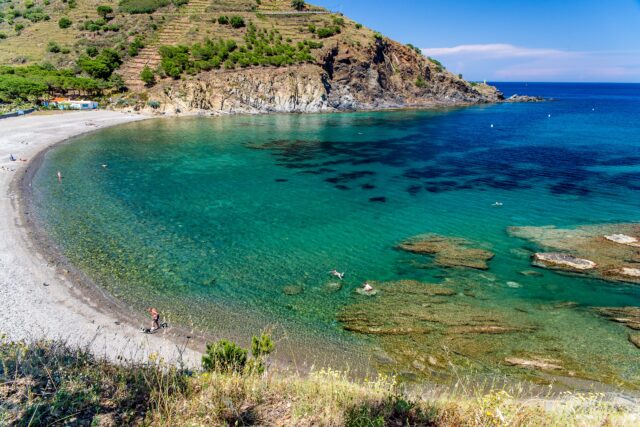
Between Banyuls-sur-Mer and Cerbère, where the Albères plunge into the Mediterranean, the marine nature reserve protects 650 hectares of sea along 6.5 kilometres of coastline, from the Île Grosse to Cap Peyrefite. Created in 1974, it is the first exclusively marine reserve in France; its status was established by decree in 1990, and the Département des Pyrénées-Orientales has managed it since 1977.
The seabed drops away quickly: a depth of 60 metres is reached less than 2 kilometres from the shore. The reserve shelters three major Mediterranean habitats: the calcareous algae rim at the water’s edge, the Posidonia seagrass meadows, and the coralligenous reef, highly developed off the capes, where red coral lives. Some 1,200 animal species and 500 plant species have been recorded here.
Around Cap Rédéris, a 65-hectare area of reinforced protection prohibits all fishing, diving and anchoring. The “reserve effect” is spectacular here: from around ten in the 1980s, the number of groupers has risen to more than 700 in 2024, and brown meagre, dentex, spiny lobsters and lobsters are repopulating the seabed. The reserve has received the IUCN “Green List” label, renewed in 2024 for its 50th anniversary.
To discover it without a tank, the underwater trail at Peyrefite beach offers a marked 250-metre route in summer, to be swum with fins, mask and snorkel, free of charge and supervised. A project to extend the reserve to more than 1,600 hectares was submitted to public inquiry in spring 2026.
Key figures
- Creation
- 1974
- Area
- 650 ha of sea
- Reinforced protection zone
- 65 ha (Cap Rédéris)
- Protected coastline
- 6.5 km
- Species recorded
- around 1,200 animal and 500 plant
- Groupers
- more than 700 (2024)
Wildlife, plants and landscapes
The return of the groupers
Almost vanished in the 1980s, groupers now number more than 700 in the reserve: a strong sign of the effectiveness of protection.
The Posidonia meadow
This flowering plant, not an alga, forms underwater meadows that shelter and feed many fish; in the reserve, it grows to a depth of some fifteen metres.
The coralligenous reef
Off the capes, these structures built by calcareous algae shelter very rich life, including red coral, a protected species.
A no-fishing zone
Around Cap Rédéris, fishing, diving and anchoring are prohibited: this is where wildlife recovers fastest.
Listening to the sea
On the underwater trail, an audio commentary can be heard through a snorkel fitted with a small speaker that transmits the sound through the teeth.
Fifty years of protection
In 2024, the reserve celebrated its 50th anniversary, with the oceanographer François Sarano and the freediver Guillaume Néry as patrons.
When to go
The Peyrefite underwater trail is open free of charge, under the supervision of lifeguards, from 15 June to 15 September, every day (check opening hours with the Département). A calm sea offers the best visibility. Scuba diving in the reserve requires prior authorisation.
Getting there
Peyrefite beach is on the D914 road, between Banyuls-sur-Mer and Cerbère, with free parking and an information point in summer. In the reserve, spearfishing and the gathering of shellfish are prohibited, and boat speed is limited to 5 knots within 300 metres of the coast. Information: 04 68 88 09 11.
Not to be missed
- The Peyrefite underwater trail, with fins, mask and snorkel
- The viewpoint and orientation table at the Esperades rest area
- Cap Rédéris, seen from the coastal path
- The aquarium of the Arago laboratory, the Biodiversarium, in Banyuls-sur-Mer
- The reserve's information point, on the port of Banyuls
Walks nearby
Plan your visit
Sources
- Département des Pyrénées-Orientales : plaquette de la réserve marine
- Département des Pyrénées-Orientales : dépliant de la réserve marine
- Département des Pyrénées-Orientales : les 50 ans de la réserve (2024)
- Département des Pyrénées-Orientales : saison 2024 du sentier sous-marin
- Décret n° 90-790 du 6 septembre 1990
- Département des Pyrénées-Orientales : enquête publique sur l’extension (2026)
- Wikidata Q3457481
Text written by Éden Catalán from these sources. Spotted a mistake? Write to us.