 fr
 es
 en
Orgues d’Ille-sur-Têt
Les Orgues d’Illa
Listed site (1981)Sculpted by erosion from sands and clays some 5 million years old, the fairy chimneys of the Orgues raise their columns opposite the Canigó, half an hour from Perpignan.
Visit Opening hours, prices, access and events on site ↓Overview
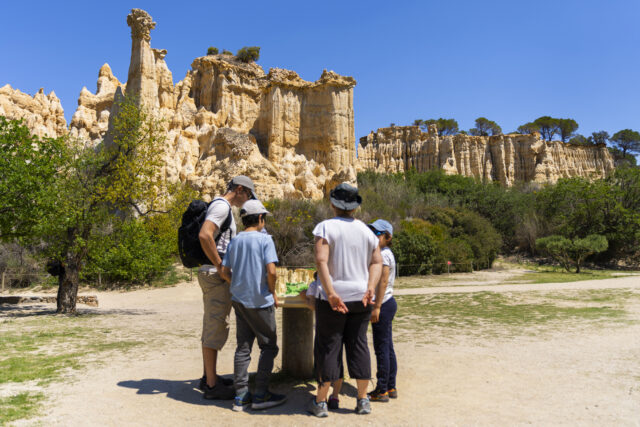
On the left bank of the Têt, on the outskirts of Ille-sur-Têt, a maze of pale columns some ten metres high rises from land long considered barren: it was once known as « Els Terrers », the arid lands. These are the Orgues, among the most spectacular fairy chimneys in France, with the Canigó as a backdrop.
Their story begins nearly 6 million years ago. The Mediterranean, almost dried up, then dropped by more than 1,500 metres and the rivers carved deep canyons. When the sea returned, 5.3 million years ago, the Roussillon became a gulf: marine sands and clays filled the valleys. At the start of the cold periods of the Quaternary, a sheet of gravel and boulders covered these soft layers.
The Orgues are born of differential erosion. The Mediterranean rains, often violent, gully the sands, but where a hard block protects the rock, a column survives beneath its « cap ». When the cap finally falls, the column wears away much faster: the landscape is constantly changing.
Listed in 1981, the site was still a peach orchard, farmed until 1992. The commune then bought it and developed it to welcome the public; it now manages it alone. The visit is on foot, along waymarked paths: climbing the columns, which are very fragile, is forbidden.
Key figures
- Height of the columns
- about ten metres
- Age of the sediments
- about 5 million years (Pliocene)
- Listed site
- since 1981
- Management
- commune of Ille-sur-Têt
- Self-guided visit
- 45 min to 1 hr
- Adult ticket 2026
- €5
Wildlife, plants and landscapes
Differential erosion
Each column of soft sand owes its survival to a more resistant « cap »; when it falls, the column wears away much faster.
The rubble cap
Gravel and boulders deposited at the start of the cold periods of the Quaternary crown the older layers.
Marine sands and clays
The clays were deposited in deep water; the sands form former delta slopes, inclined at up to 35°.
An almost dried-up Mediterranean
Nearly 6 million years ago, the sea dropped by more than 1,500 metres and the rivers carved canyons, later filled by sediments.
An orchard turned natural site
When it was listed in 1981, the site was a peach orchard, farmed until 1992.
A living landscape
In 2026, heavy rains opened a 40-metre gully at the entrance to the site: erosion carries on with its work.
When to go
The site is open almost all year round, with an annual closure from mid-December to early January. Opening hours vary with the season: in 2026, from 8.15 am to 7 pm in July and August, from 9.30 am to 7 pm in spring and in September, afternoons only in winter; the ticket office closes one hour earlier. The late-afternoon light gilds the columns; in summer, arriving early helps you avoid the heat.
Getting there
From Perpignan (about 30 minutes), head for Ille-sur-Têt, then take the D2 towards Montalba: after the bridge over the Têt, turn right onto the chemin de Régleilles; the car park and ticket office are 300 metres further on. If travelling by bus or train to Ille-sur-Têt, allow about 3 km on foot.
Not to be missed
- The maze of paths between the fairy chimneys
- The view of the Orgues with the Canigó in the background
- The guided tour and its legends of fairies and goblins
- For children: looking for animal shapes and faces in the rock
Plan your visit
Sources
- Site des Orgues : genèse d’un paysage
- Site des Orgues : horaires et tarifs
- Site des Orgues : durée de visite
- Site des Orgues : localisation
- Tourisme Pyrénées-Orientales : les Orgues d’Ille-sur-Têt
- Wikidata Q3356248
Text written by Éden Catalán from these sources. Spotted a mistake? Write to us.